This 4-week exercise regimen is intended for guys who wish to gain lean muscle, increase their level of fitness, and lose weight. It includes one active-recovery day, three cardio or HIIT sessions, three full-body strength exercises, and 8,000–10,000 daily steps.
It is typically recommended that adults engage in at least two days of muscle-strengthening activities and at least 150 minutes of moderate-intensity aerobic activity each week. These fundamental suggestions are met by this design, which progressively goes beyond them.
Safety note: If you have heart disease, high blood pressure, diabetes, joint problems, or have been inactive for a long time, consult a qualified healthcare professional before starting. Stop if you feel chest pain, severe dizziness, or unusual shortness of breath.
How to Follow This Plan
Weekly Workout Schedule
| Day | Workout | Duration |
|---|
| Day | Workout | Duration |
|---|---|---|
| Monday | Full-Body Strength A | 40–60 minutes |
| Tuesday | Cardio or HIIT 1 | 20–30 minutes |
| Wednesday | Full-Body Strength B | 40–60 minutes |
| Thursday | Cardio or HIIT 2 | 20–30 minutes |
| Friday | Full-Body Strength C | 40–60 minutes |
| Saturday | Cardio or HIIT 3 | 20–30 minutes |
| Sunday | Rest or active recovery | 20–40 minutes |
Complete 8,000–10,000 steps every day, including rest days. You can divide your steps into a morning walk, short walking breaks during work, and an evening walk.
Warm-Up Before Every Workout
Perform this 5–10-minute warm-up before strength training, cardio, or HIIT. A warm-up gradually prepares the body for moderate or vigorous activity.nhsinform
-
2–3 minutes of brisk walking, light jogging, or cycling.
-
Arm circles: 15 forward and 15 backward.
-
Bodyweight squats: 10 repetitions.
-
Hip circles: 10 repetitions per side.
-
Walking lunges: 8 repetitions per leg.
-
Shoulder rolls and leg swings: 10 repetitions each.
-
Perform one light practice set before your first loaded exercise.
Cool-Down After Every Workout
Spend 5–10 minutes cooling down. Gradually reduce your pace instead of stopping suddenly, then stretch the muscles used during training.nhsinform
-
Slow walk: 3–5 minutes.
-
Standing quadriceps stretch: 15–30 seconds per side.
-
Hamstring stretch: 15–30 seconds per side.
-
Chest and shoulder stretch: 15–30 seconds.
-
Calf stretch: 15–30 seconds per side.
-
Breathe slowly and drink water.
Full-Body Strength Workouts
Use controlled movement and stop each set with approximately 1–3 good repetitions left in reserve. Rest for 60–90 seconds between sets, or up to 2 minutes after demanding leg exercises.
The beginner version uses mostly 1–3 sets of 8–12 repetitions, which aligns with commonly used resistance-training recommendations for beginners. NHS: Warm-Up and Cool-Down Activities
Strength Workout A: Squat, Push and Pull
| Exercise | Beginner | Intermediate | Home Option | Gym Option |
|---|---|---|---|---|
| Squat | 2 × 10–12 | 3 × 8–12 | Bodyweight or backpack squat | Barbell or goblet squat |
| Push-up or chest press | 2 × 8–12 | 3 × 8–12 | Incline or floor push-up | Bench press or chest press |
| One-arm row | 2 × 10 each side | 3 × 8–12 each side | Backpack or dumbbell row | Cable or dumbbell row |
| Romanian deadlift | 2 × 10–12 | 3 × 8–10 | Backpack or dumbbells | Barbell or dumbbells |
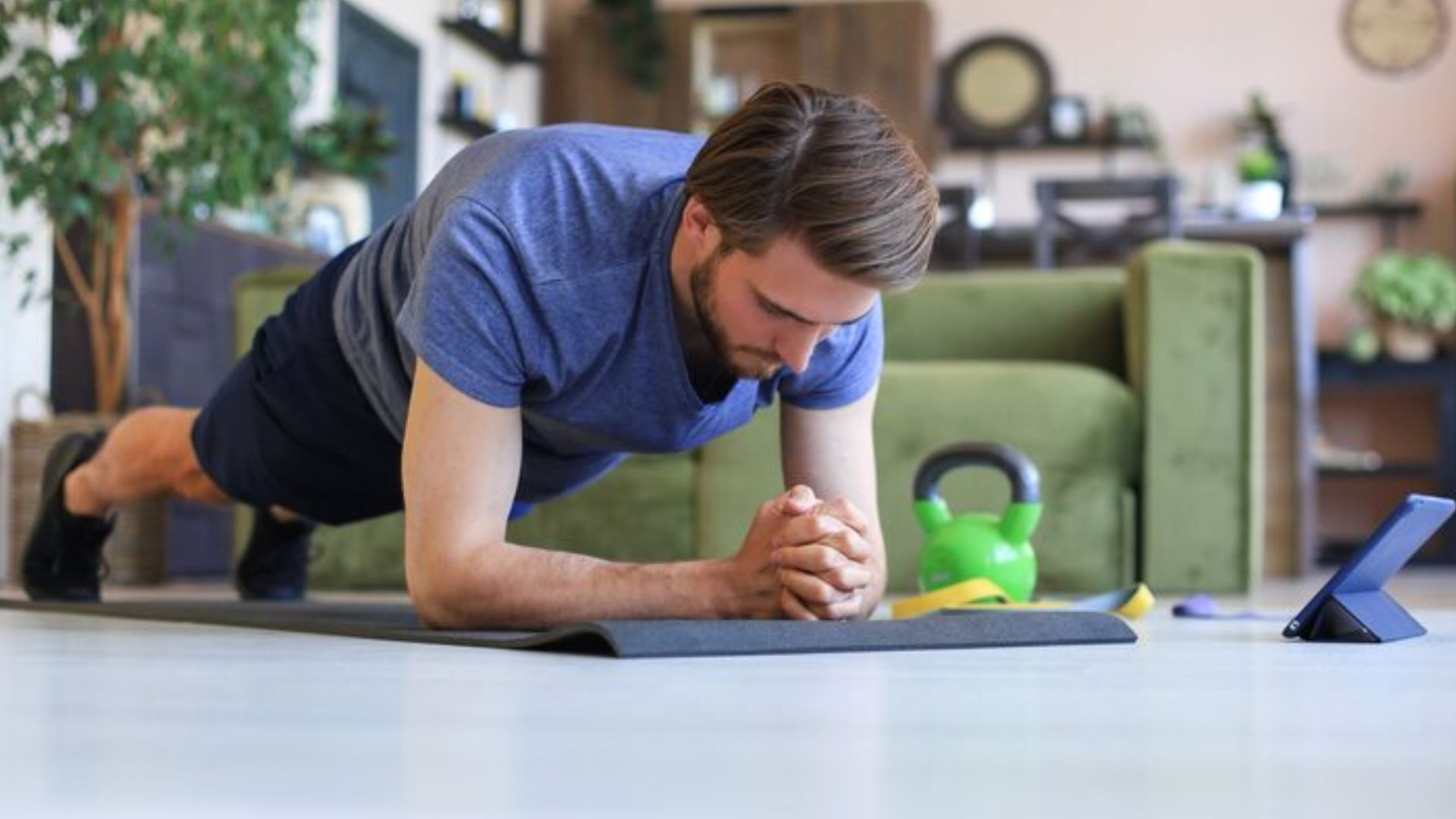
| Plank | 2 × 20–30 seconds | 3 × 30–60 seconds | Forearm plank | Weighted plank |
| Reverse lunge | 2 × 8 each leg | 3 × 10 each leg | Bodyweight or dumbbells | Dumbbell or barbell lunge |
Technique Tips
Keep your chest lifted during squats, brace your abdomen during rows and deadlifts, and avoid allowing your lower back to round. Perform every repetition through a comfortable range of motion.
Strength Workout B: Hinge, Press and Core
| Exercise | Beginner | Intermediate | Home Option | Gym Option |
|---|---|---|---|---|
| Hip thrust or glute bridge | 2 × 12–15 | 3 × 10–12 | Bodyweight or backpack | Barbell hip thrust |
| Overhead press | 2 × 10–12 | 3 × 8–12 | Dumbbells or water bottles | Dumbbell or barbell press |
| Step-up | 2 × 8 each leg | 3 × 10 each leg | Sturdy step or stairs | Bench step-up |
| Lat pulldown or assisted pull-up | 2 × 10–12 | 3 × 8–12 | Resistance-band pulldown | Lat pulldown or pull-up |
| Split squat | 2 × 8 each leg | 3 × 8–12 each leg | Bodyweight or dumbbells | Dumbbells or Smith machine |
| Dead bug | 2 × 8 each side | 3 × 10 each side | Floor exercise | Floor exercise |
Home Training Alternative
If you do not have dumbbells, use a loaded backpack, water bottles, resistance bands, or household objects that can be held securely. Increase difficulty by slowing the lowering phase to 3 seconds or adding repetitions.
Strength Workout C: Full-Body Conditioning
| Exercise | Beginner | Intermediate | Home Option | Gym Option |
|---|---|---|---|---|
| Sit-to-stand or goblet squat | 2 × 10–12 | 3 × 8–12 | Chair squat or backpack squat | Leg press or front squat |
| Incline push-up | 2 × 8–12 | 3 × 8–15 | Countertop or bench push-up | Dumbbell or machine press |
| Dumbbell or backpack row | 2 × 10–12 | 3 × 8–12 | Backpack row | Seated cable row |
| Kettlebell deadlift or swing | 2 × 10–12 | 3 × 12–15 | Backpack deadlift | Kettlebell deadlift or swing |
| Lateral lunge | 2 × 8 each side | 3 × 10 each side | Bodyweight | Dumbbell lateral lunge |
| Mountain climber | 2 × 20–30 seconds | 3 × 30–45 seconds | Slow or regular pace | Sled push or battle ropes alternative |
Beginners should master the movement pattern before adding weight or speed. Intermediate users can increase resistance when they complete all prescribed repetitions with good form.
Cardio and HIIT Workouts
Use the talk test to control intensity. During moderate cardio, you should be able to speak in short sentences. During HIIT intervals, work hard but maintain safe technique.
Cardio Workout 1: Intervals
Beginner Version — 20 Minutes
-
Warm-up: 5 minutes.
-
Brisk walk: 1 minute.
-
Easy walk: 1 minute.
-
Repeat for 10 rounds.
-
Cool-down: 5 minutes.
Intermediate Version — 25–30 Minutes
-
Warm-up: 5 minutes.
-
Fast walk, jog, cycling, or rowing: 45 seconds.
-
Easy pace: 75 seconds.
-
Repeat for 10–12 rounds.
-
Cool-down: 5 minutes.
Cardio Workout 2: Low-Impact HIIT
Complete the following circuit for 3–5 rounds:
| Exercise | Beginner | Intermediate |
|---|---|---|
| Marching high knees | 30 seconds | 40 seconds |
| Bodyweight squats | 30 seconds | 40 seconds |
| Step jacks | 30 seconds | Jumping jacks, 40 seconds |
| Incline mountain climbers | 30 seconds | Mountain climbers, 40 seconds |
| Rest | 60 seconds | 40 seconds |
Include a 5-minute warm-up and a 5-minute cool-down. Beginners should use low-impact variations and focus on steady movement rather than maximum speed. CDC: Physical Activity Guidelines for Adults
Cardio Workout 3: Steady-State Cardio
Beginner Version
-
5-minute warm-up.
-
15–20 minutes of brisk walking, easy cycling, or elliptical training.
-
5-minute cool-down.
Intermediate Version
Four-Week Progression Plan
Week 1: Learn the Movements
-
Beginners: Perform 2 sets for most strength exercises.
-
Intermediate users: Perform 3 sets where the workout table allows.
-
Use a comfortable resistance and prioritise technique.
-
Complete 20 minutes of cardio.
-
Aim for at least 8,000 steps per day.
Week 2: Add Repetitions
-
Keep the same exercises.
-
Add 1–2 repetitions per set if your form remains strong.
-
Increase cardio sessions to 22–25 minutes.
-
Try to reach 8,500–9,000 steps daily.
-
Do not increase weight and repetitions at the same time.
Week 3: Increase Training Demand
-
Add one set to selected exercises if recovery is good.
-
Intermediate users can increase the weight by approximately 5–10%.
-
Add 2–3 HIIT intervals or one extra circuit round.
-
Aim for 9,000–10,000 steps per day.
-
Keep at least one full rest or active-recovery day.
Week 4: Consolidate and Test Progress
-
Maintain the same exercises and use slightly heavier resistance only if technique is consistent.
-
Beginners should avoid training to failure.
-
Intermediate users can work near the top of the repetition range.
-
Complete 25–30 minutes of cardio.
-
Record body weight, waist measurement, step average, and workout performance.
Rest and Active Recovery
On Sunday, avoid intense training. Choose one or two easy activities:
-
20–40-minute relaxed walk.
-
Gentle mobility for the hips, shoulders, ankles, and spine.
-
Light stretching.
-
Easy cycling.
-
Foam rolling if it feels comfortable.
Sleep, hydration, and a nutritious eating pattern are important for recovery and weight management. The workout plan can support fat loss, but results also depend on overall food intake, sleep, stress, and consistency.
-
5-minute warm-up.
-
20–30 minutes of brisk walking, jogging, cycling, rowing, or elliptical training.
-
Add a 30-second faster section every 5 minutes if you can maintain good form.
-
5-minute cool-down.
Choose low-impact cardio if running causes knee, ankle, or back discomfort. Swimming, cycling, rowing, and elliptical training can reduce impact while still increasing energy expenditure.
Beginner vs Intermediate Rules
| Training Level | Recommended Approach |
|---|---|
| Beginner | Use bodyweight or light resistance, perform 1–2 sets initially, choose low-impact cardio, and focus on technique |
| Intermediate | Use moderate resistance, perform 2–3 sets, add progressive overload, and include jogging or higher-impact intervals if comfortable |
| Both levels | Maintain daily steps, warm up, cool down, and stop if pain occurs |
Frequently Asked Questions
Can I do this plan at home?
Yes. Use bodyweight exercises, resistance bands, dumbbells, water bottles, or a loaded backpack. A sturdy chair or step can also be useful for step-ups and incline push-ups.
Is HIIT necessary for weight loss?
No. HIIT is optional. Brisk walking, cycling, rowing, or other steady-state cardio can also improve fitness and support a calorie-controlled weight-loss plan.
Should I train on consecutive days?
The schedule separates strength and cardio days to support recovery. If you feel unusually sore or fatigued, replace HIIT with easy walking or take an additional rest day.
How long should I follow the plan?
Follow it for four weeks, assess your recovery and progress, then repeat it with small adjustments. Increase resistance or repetitions gradually rather than changing every exercise at once.