The majority of "no equipment" exercises are inefficient. They combine ten planks, ten push-ups, and ten squats, call it a day, and question why no one notices any improvement. In actuality, bodyweight training may develop true muscle, strength, and fitness, but only if the key factors—leverage, pace, range of motion, and rest—are controlled. That's what this routine accomplishes. No gym, no equipment, and no justifications.
Why This Works
Muscles don't know the difference between a barbell and your own bodyweight — they only respond to tension, fatigue, and progressive overload. You can create serious overload without equipment by slowing exercises down, reducing rest, using single-limb variations, and changing leverage (elevating feet, changing angles). This workout uses all four techniques.
Warm-Up (5 Minutes)
Do each for 30 seconds, no rest between:
- Arm circles
- Bodyweight squats
- World's greatest stretch (lunge with rotation)
- Inchworms
- High knees
This raises core temperature and opens up the hips and shoulders before loading them.
The Workout
Perform this as a circuit: complete one set of each exercise in order, then rest, then repeat for 3–4 total rounds. Beginners do 3 rounds; intermediate/advanced do 4. Rest 60–90 seconds between rounds, not between exercises — that's what makes this genuinely hard.
1. Push-Ups — 8–15 reps
Targets: chest, shoulders, triceps, core Hands slightly wider than shoulders, body in a straight line from head to heels, elbows tracking back at roughly 45 degrees (not flared to 90). Lower until your chest is an inch off the floor, then press up without letting your hips sag or pike up.
- Beginner: incline push-ups (hands on a couch or step)
- Advanced: archer push-ups or feet-elevated push-ups
2. Bodyweight Squats → Jump Squats — 15 reps (or 8 jump squats)
Targets: quads, glutes, hamstrings Feet shoulder-width, chest up, push hips back first, then bend knees, keeping them tracking over your toes. Drop until thighs are at least parallel to the floor. Drive through the whole foot to stand.
- Beginner: bodyweight squats only, controlled tempo
- Advanced: jump squats, landing soft with bent knees
3. Inverted Rows (Table Rows) — 8–12 reps
Targets: back, biceps, rear delts — the "pulling" muscle group most bodyweight routines skip entirely Lie under a sturdy table or use a low bar. Grip the edge, body straight, and pull your chest toward it, squeezing your shoulder blades together. This is the single most underused exercise in home workouts, and it's essential — pushing without pulling creates muscular imbalance.
- Beginner: bend knees, feet flat, steeper body angle
- Advanced: straighten legs fully, or elevate feet
4. Reverse Lunges — 10 reps per leg
Targets: glutes, quads, hamstrings, balance/stability Step back, lower the back knee toward the floor while keeping the front shin vertical. Push through the front heel to return to standing. Keep your torso upright throughout.
- Beginner: hold onto a wall or chair for balance
- Advanced: add a knee drive/hop at the top (jump lunges)
5. Pike Push-Ups — 6–12 reps
Targets: shoulders, upper chest, triceps Form an inverted V with your body, hands under shoulders, hips high. Lower your head toward the floor between your hands, then press back up. This is your shoulder-press substitute.
- Beginner: keep knees slightly bent, hips lower
- Advanced: elevate feet on a step for a steeper angle
6. Single-Leg Glute Bridges — 10 reps per leg
Targets: glutes, hamstrings, lower back Lie on your back, one foot planted, other leg extended. Drive through the planted heel, squeezing the glute at the top without arching your lower back excessively. Lower with control.
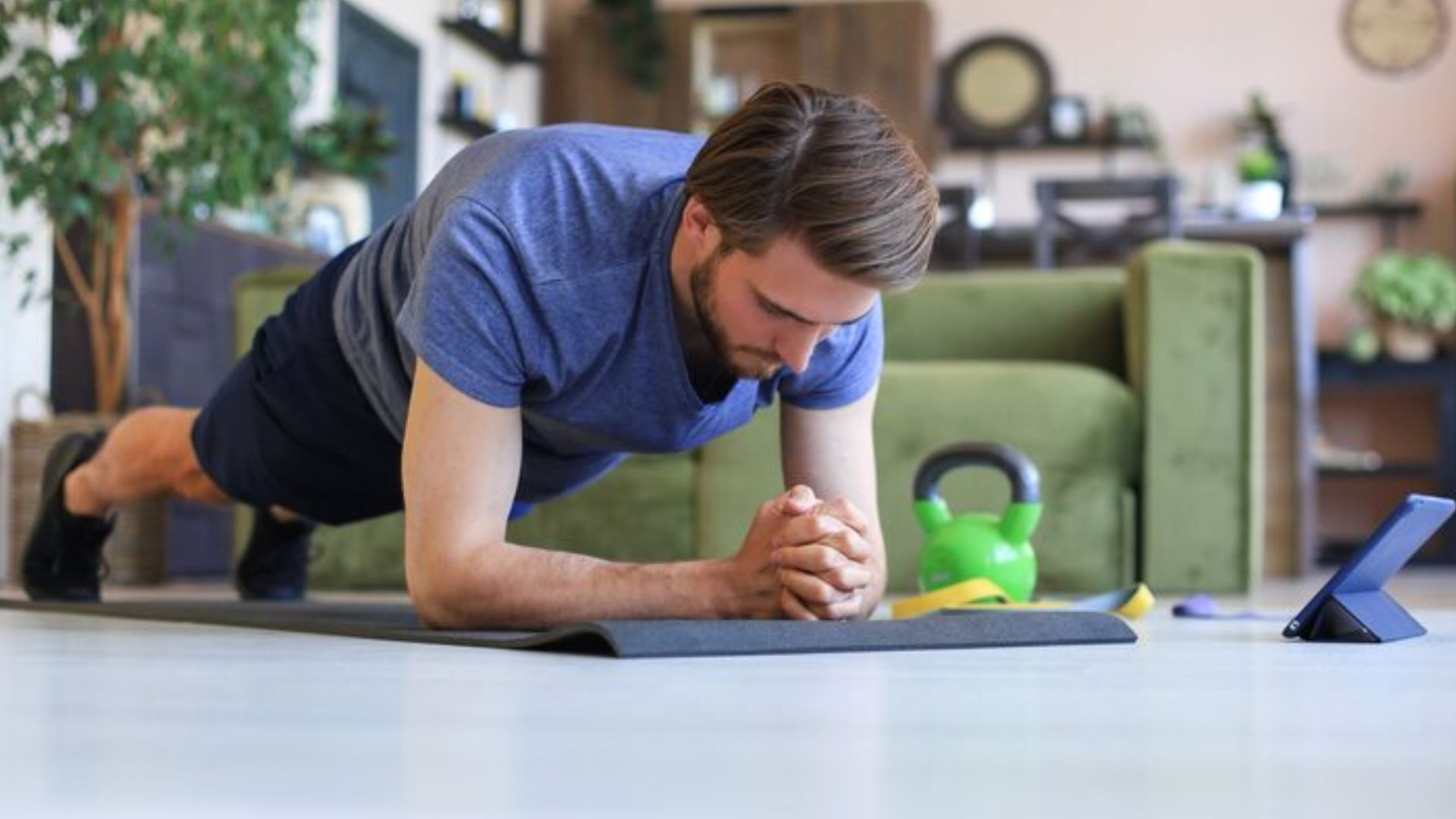
7. Plank with Shoulder Taps — 30–45 seconds
Targets: core (anti-rotation), shoulders Hold a high plank, feet slightly wider than hip-width for stability. Tap opposite shoulder with each hand while keeping hips as still as possible — resist the urge to rock side to side.
- Beginner: wider stance, slower taps
- Advanced: narrow stance, add a push-up between taps
8. Mountain Climbers — 30 seconds
Targets: core, hip flexors, cardio conditioning From a plank, drive knees toward your chest in a running motion, keeping hips low and back flat. This finishes the round with an elevated heart rate, adding a conditioning element on top of strength work.
Cool-Down (5 Minutes)
Static stretches held for 30 seconds each: chest doorway stretch, standing quad stretch, seated hamstring stretch, child's pose, and hip flexor lunge stretch. This helps with recovery and preserves range of motion.
Only when you continue to increase the difficulty of the exercise will it remain effective. Add a round, cut down on rest by 10 to 15 seconds, slow your pace (attempt a 3-second lowering phase on push-ups and squats), or switch to an advanced variant of an exercise every 1 to 2 weeks. This is progressive overload without the use of weights, which is why bodyweight training can actually increase strength rather than just endurance.
For guidance on proper exercise form and injury prevention from a certified source, the American Council on Exercise (ACE) exercise library is a solid reference to cross-check technique. And if you're building out a full weekly plan, pairing this with a rest-day mobility or stretching routine can help you recover faster and stay consistent — check out our guide to active recovery days for more on that.
Do this 3–4 times per week with at least one rest or active-recovery day between sessions, and you'll have a complete, equipment-free strength program you can do anywhere — a hotel room, a park, or your living room floor.